
According to the yogic tradition, the human body contains 72,000 subtle energy channels flowing throughout the body around three principal currents: the central channel already mentioned and two others, one on each side, known as iḍā (on the left) and piṅgalā (on the right).
Breath practices (prāṇāyāma), energetic seals (mudrā) and energetic locks (bandha) purify these channels in order to awaken the dormant vital force at the base of the spine, allowing it to rise and unite with consciousness.
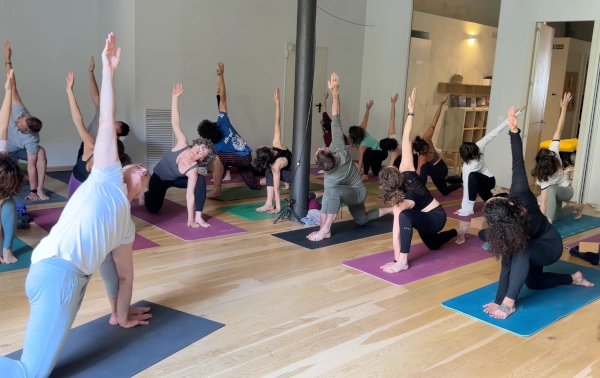
Today, many practitioners focus mainly on the practice of postures. On its own, this is already a profound physical and energetic discipline, offering benefits that reach far beyond what may be immediately apparent. When this practice is deeply rooted in the breath and developed with physical and energetic balance, it naturally opens the way towards a more complete practice, leading the practitioner towards Raja Yoga
.Raja Yoga is the path that focuses on calming the fluctuations of the mind — the constant stream of thoughts. Its principal tools are concentration and meditation, which gradually lead towards mental stillness and inner silence, allowing consciousness to reveal itself as it truly is. It helps us reconnect with what we truly are, beyond change and impermanence.
Raja Yoga is founded upon a way of living that seeks to avoid creating friction both with the world around us and within ourselves, following a path of self-knowledge and surrender. It is traditionally associated with the Yoga Sūtras of Patañjali (2nd century CE).
The practice of Hatha Yoga postures, when firmly established in the breath, naturally leads to the experience of the withdrawal of the senses (pratyāhāra), which forms the basis of the concentration required for its true fruit to emerge: meditation, and through meditation, the experience of inner fulfilment.
As one of the earliest texts on Hatha Yoga, the Haṭhayogapradīpikā (15th century), expresses it:“haṭhasya prathamaṃ gatvā rājayogam nigacchati” “Hatha Yoga is the first step; through it one reaches Raja Yoga.” (Haṭhayogapradīpikā 1.4)These two paths of yoga are, in reality, one and the same path.
